Lighting a Highway Resurfacing Job: Light Tower Spacing for Linear Works
Road works are lit differently from building sites. A resurfacing job is a moving line, not a fixed area, and spacing the towers along that line is what decides whether the paver crew can see the joint at 3 a.m.

Linear Works Are a Different Lighting Problem
A building site is an area — a road job is a line
On a building site you light a rectangle and the crew works inside it. On a resurfacing job the work is a strip a few metres wide and hundreds of metres long, and it moves along that strip through the night.
Applying an area-based calculation to a linear job gives you the wrong answer in both directions: too many towers for the square metres involved, and too few at the points that actually matter. 🛣️
The good news
Road works are open, flat and free of the obstruction that plagues vertical construction. On the strip itself, one mast at full height goes a long way — you are planning positions, not fighting shadows.
The Four Zones of a Resurfacing Job
1. The taper and advance warning
Where traffic is being moved out of the closed lane. This is a traffic-safety zone rather than a work zone, and it needs to be visible without dazzling approaching drivers.
2. The milling face
Where the planer is cutting. The operator needs to see the cut line and the crew needs to see the machine's movement envelope.
3. The paving train
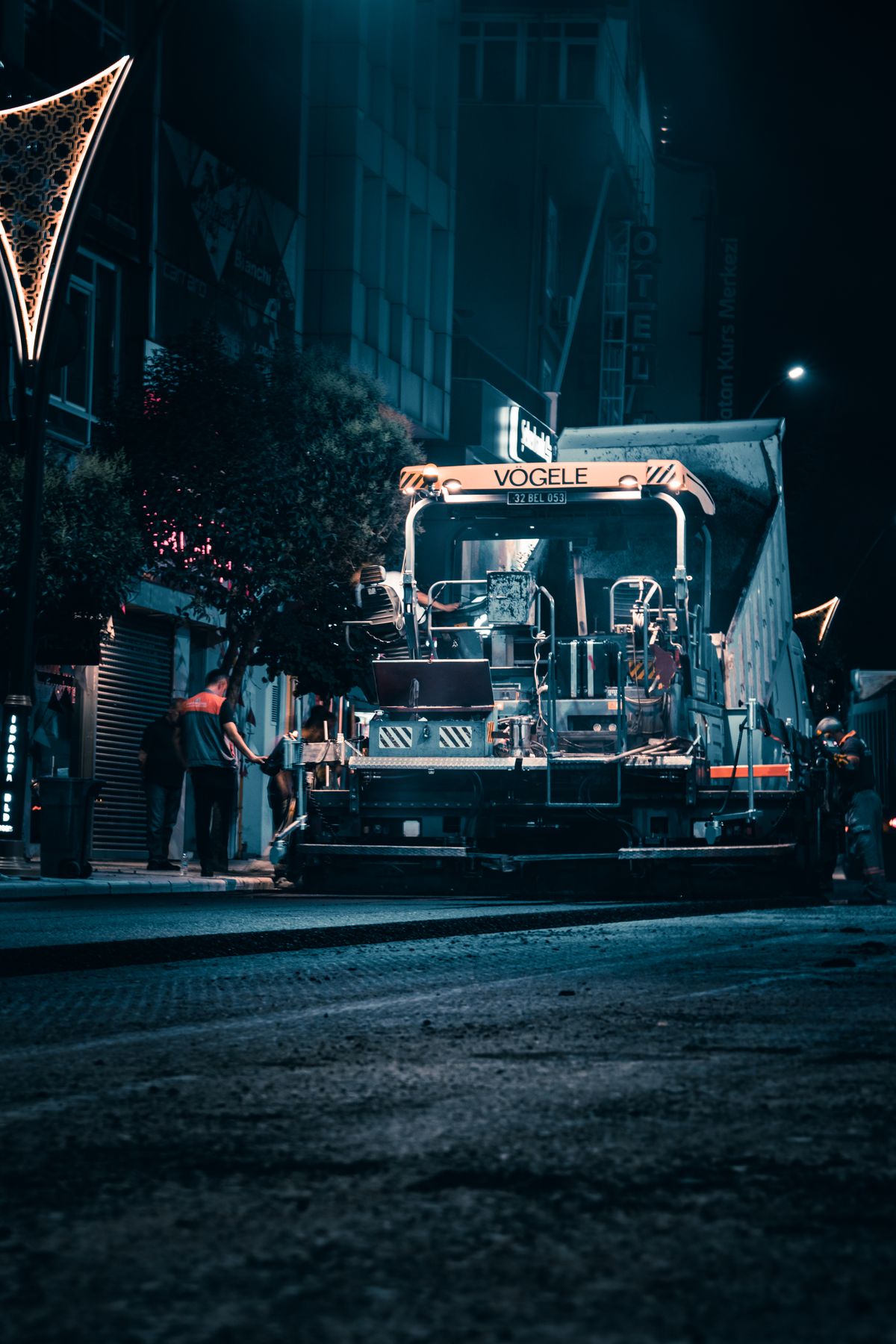
Paver, rollers and the material transfer point. This is the busiest and most hazardous zone — vehicles reversing, hot material, crew on foot between machines.
4. The joint and finishing zone
Behind the rollers, where joints are checked and edges dressed. Detail work, and the one place where general lighting alone is often not enough.
Spacing Towers Along the Alignment
Think in positions, not square metres
For linear works we plan around roughly 4,000 m² of coverage per tower, which for a typical two-lane closure translates into towers spaced along the alignment rather than spread across an area.
A practical starting arrangement for a moving resurfacing operation:
- One unit at the paving train — this is the priority position and it moves with the train
- One unit at the milling face if milling and paving are running as separate operations on the same closure
- One unit covering the material transfer and turning area, where trucks reverse
- Lighting at the taper, positioned and aimed so it marks the closure without glaring at approaching traffic
Overlap at the seams
Between positions, aim the outer heads so the light pools overlap. On a road job the seam between two lit zones usually sits exactly where crew walk between machines.
Adjust for the closure length
A 300 m closure and a 1.5 km closure are different jobs. Longer closures need units repositioned as the train advances, which is a shift-planning decision more than a hire decision.
Keeping Glare Off Live Traffic
This is the part that gets road jobs stopped
A light tower aimed across a carriageway puts glare directly into the eyes of drivers doing 80 km/h past your crew. It is a serious hazard and it is entirely avoidable.
- Raise the mast to full height. Height means the light comes downward onto the work rather than horizontally into windscreens.
- Aim inward, into the closure. Nothing should be pointed across the barrier line.
- Set up before traffic management goes live, so aiming adjustments do not happen with cars passing.
- Drive the approach yourself. Once the units are lit, drive past in the live lane at speed and look at what the driver sees. Then fix it.
That last step takes ten minutes and catches almost everything.

Lighting a Job That Moves Every Night
Repositioning is the whole point of a towable unit
Because the unit is trailer-mounted with a winch and outriggers, the crew lowers the mast, tows it forward and stands it back up. On a resurfacing job this may happen several times a shift.
Build the time into the plan. A tower that takes fifteen minutes to move and gets moved four times has consumed an hour of the shift, and that hour should be scheduled rather than discovered.
Lower the mast before towing, every time
It sounds obvious. It is also the most common cause of damage on road jobs, usually involving an overhead sign gantry.
Watch the shoulder
Outriggers on a soft shoulder sink. Use pads, and check the unit is still level after the first hour.
Pre-Shift Lighting Checklist
- Masts at full height and secured
- All heads aimed into the closure, none across the barrier
- Overlap confirmed between adjacent positions — walk it
- Approach driven in the live lane to check driver glare
- Outriggers on pads, unit level
- Fuel checked and the refuelling point in the shift plan
- Positions and layout recorded for the risk assessment
Our guide to night work lighting duties covers what belongs in that record.
Get Lighting Tower Hire for Your Road Job
Send us the closure length, the number of shifts and the location. We deliver, position and stand up the units and quote one fixed monthly rate per tower — for road works anywhere in Malaysia, including Seremban, Tangkak and Gerik.
Frequently Asked Questions
How far apart should light towers be on a road job?
Plan by position rather than by fixed distance: one at the paving train, one at the milling face, one at the transfer and turning area, plus lighting at the taper. Then close any dark seam you find when you walk it.
How many towers for a 1 km lane closure?
It depends on how many operations run at once. A single paving train needs fewer units than a closure running milling, paving and finishing simultaneously. Send us the sequence and we will suggest a count.
Can the units be moved during the shift?
Yes — that is what the trailer, winch and outriggers are for. Lower the mast fully before towing, every time.
Do light towers need site power on a road job?
No. Each unit has a silent diesel generator on board, which is exactly why they suit road works — there is nowhere to plug in on a closed carriageway.
How do I stop glare affecting passing traffic?
Full mast height, all heads aimed inward, and a drive-past check in the live lane before the shift starts.
The Short Version
Light the operations, not the area. Put a unit at the paving train, one at the milling face, one at the turning area, and light the taper without dazzling anyone.
Then drive past your own closure at speed and look at what the driver sees. It is the cheapest safety check on the job. 🛣️