How Many Light Towers Does Your Site Need? A Coverage Guide
Most contractors book light towers by guesswork and either run short or pay for units they never switch on. This guide walks through the area-first method for working out a realistic tower count, what changes it on a real Malaysian site, and where to place the masts.

Why the Tower Count Is Usually Wrong
Nobody budgets for lighting until the night shift is already approved
Site lighting tends to get sorted out last. The night works are approved, the pour is scheduled, and someone asks on Friday afternoon how the site is going to be lit on Monday.
What follows is a guess. Either two towers arrive for an area that needed four and the crew works in shadow, or six arrive for a job that needed three and the client pays for units that sit switched off in a corner.
Both mistakes cost money. The second one costs it quietly, every month, which is why it survives so long. 💡
Start With the Area, Not the Number of Lamps
Lamp wattage tells you almost nothing on its own
The instinct is to compare wattage — this tower has 4 × 500 W, that one has something else, so how many do I need? Wattage is a useful shorthand for how much light a unit produces, but it says nothing about how far that light usefully reaches once the mast is up.
The number that actually drives the count is the working area you need lit, in square metres. Get that first, then divide.
Measure the working area, not the site boundary
A 20,000 m² site does not need 20,000 m² of light. It needs light where people and plant are moving after dark — the pour, the haul road, the laydown yard, the access gate.
Pull the site plan, mark the areas that will be live at night, and add up only those. On most jobs this cuts the number in half before you have hired anything.
What One Tower Realistically Covers
The planning figure we use
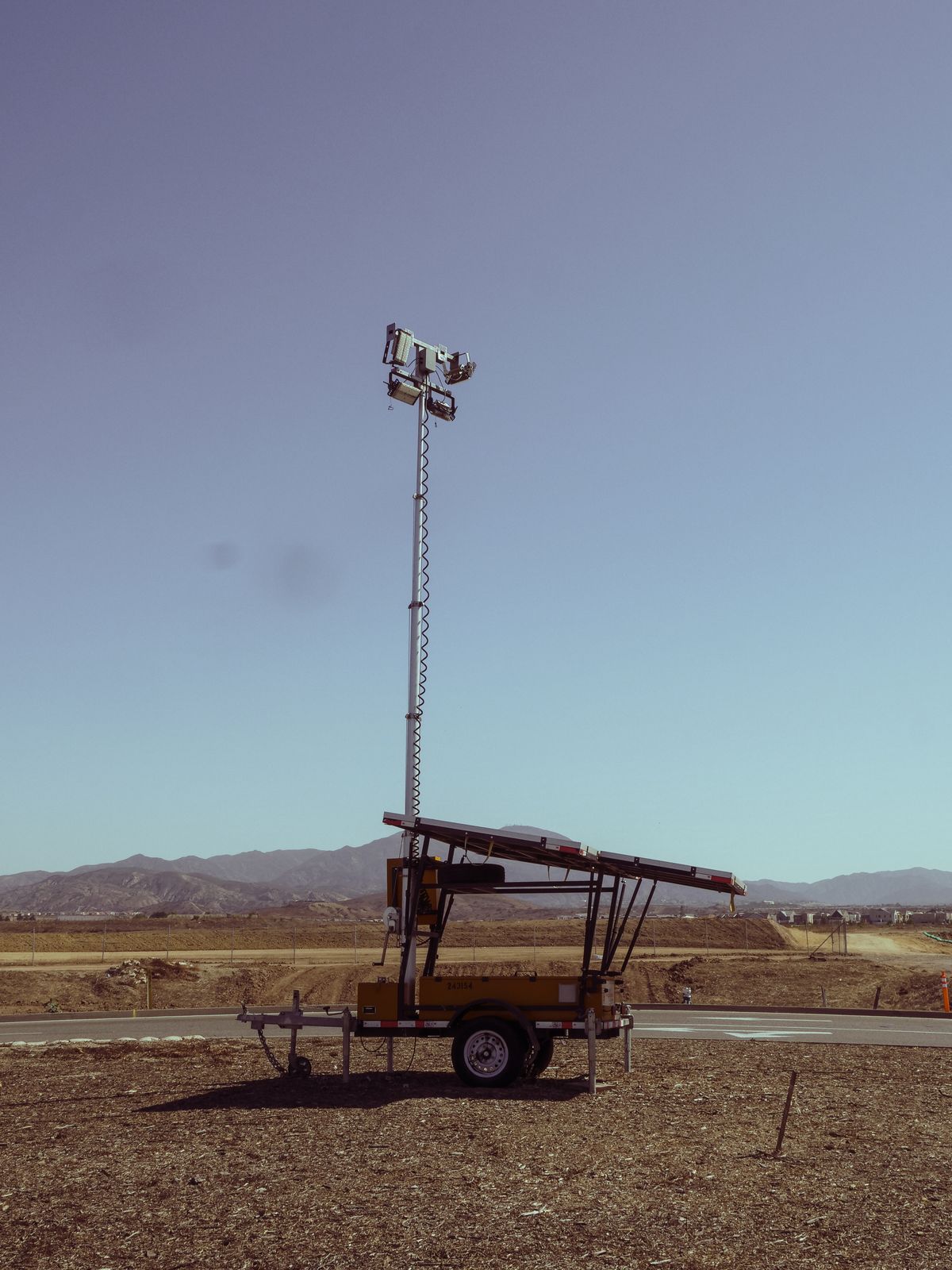
For planning purposes we work on roughly 3,000 to 4,000 m² of usable coverage per light tower on open ground, with the mast fully extended to 8 m and the four 500 W lamps aimed outward.
That is a planning estimate, not a specification. It is the number to use when you are budgeting and sizing a hire — not a promise about lux at any given point on your site.
What pulls the real figure down
Every one of these reduces effective coverage, sometimes sharply:
- Formwork, stacked material and site huts casting hard shadows
- Ground that slopes away from the mast
- Tasks that need close detail work rather than general movement light
- Masts that cannot be sited centrally because of access or overhead services
- Rain and haze, which scatter light and cut usable throw
If your site has three or more of the above, plan on the lower end of the range and expect to reposition units during the job.
Four Site Types, Four Different Answers
Building construction — the most obstructed case
Vertical construction is the hardest thing to light because the obstruction changes weekly. Plan around 3,000 m² per tower and assume you will move masts as the structure goes up.
Road and highway works — the easiest
Linear works are open, flat and predictable. You can plan closer to 4,000 m² per tower and think in terms of spacing along the alignment rather than area. We covered that case separately in our guide to light tower spacing for highway resurfacing.
Events and open ground
Car parks, festival grounds and temporary yards sit in between — open, but with crowd movement that makes even coverage matter more than raw brightness. Plan around 3,500 m² per tower.
Industrial and plant work
Refinery, mill and plant areas are dense with structure and pipe racks. Treat them like building construction at 3,000 m² per tower, and expect to add units for specific work fronts.

Placement Beats Adding More Towers
Two towers in the right place beat four in the wrong one
A mast in a corner throws most of its light over the hoarding and into the neighbour's compound. The same mast moved 30 m toward the centre of the work front can light the whole area on its own.
Before you hire an extra unit, walk the site after dark with the towers you already have and try repositioning. It is free, and it works more often than contractors expect.
Overlap the edges deliberately
Where two towers cover adjacent areas, aim them so the pools of light overlap by a few metres rather than meeting exactly. A dark seam between two lit zones is where people trip.
Think about glare, not just brightness
Masts aimed straight at an excavator cab or an oncoming traffic lane create glare that makes the operator's job harder. Raise the mast fully and aim slightly downward so the light lands on the work, not in someone's eyes.
Work Out Your Own Count in Five Steps
- Mark the live night areas on the site plan and add up the square metres.
- Divide by the planning figure for your site type — 3,000 to 4,000 m².
- Round up, always. A half tower does not exist.
- Add one unit if the site is heavily obstructed, split across separate work fronts, or has a critical pour that cannot stop.
- Check the monthly cost against the schedule — at RM 3,500 per tower per month, the difference between three and five units is real money over a six-month programme.
The coverage estimator on our homepage runs exactly this calculation and returns an estimated tower count and monthly total in a few seconds.
Get a Coverage Check for Your Site
Send us the area you need lit, the site type and your dates, and we will come back with a tower count and one fixed monthly rate. We rent across the Klang Valley, including tower light rental in Kuala Lumpur and light tower rental in Shah Alam, and nationwide beyond that.
Frequently Asked Questions
How many light towers do I need for a 10,000 m² construction site?
On an obstructed building site, plan for three to four towers using the 3,000 m² figure. Confirm it against your actual night work areas — you may only be lighting half the site.
Is it cheaper to hire fewer towers and move them around?
Sometimes, on jobs where work fronts run in sequence rather than at the same time. It stops being cheaper the moment repositioning eats into shift time or you need two areas lit simultaneously.
Does one light tower need site power?
No. Each unit carries its own silent diesel generator, so it runs on unserviced ground with no supply and no cable runs.
Can I change the number of towers mid-rental?
Yes. Message us with the change and we will confirm availability and adjust the rate from the change date.
What area does one tower cover on a road job?
Closer to 4,000 m² than 3,000 m², because linear works are open and unobstructed. Spacing along the alignment usually matters more than total area.
The Short Version
Work out the area you actually need lit, divide by 3,000 to 4,000 m² depending on how obstructed the site is, round up, and add a unit if the job cannot afford a dark patch.
Then spend ten minutes on placement before you spend RM 3,500 a month on an extra tower. 🔦